Bluey pads: what new ICU research tells us about reusable alternatives
October 1, 2026

Bluey pads: what new ICU research tells us about reusable alternatives
Bluey pads are widely used across healthcare and aged care environments to protect bedding, equipment and surfaces during patient care. While disposable products remain common, reusable alternatives are receiving increased attention as healthcare and aged care organisations look for practical ways to reduce waste without compromising patient care.
New Australian research has examined the transition from disposable Blueys to reusable absorbent pads in an intensive care unit, assessing pressure-injury incidence, staff acceptance and landfill-waste reduction.
The findings provide encouraging evidence for healthcare and aged care organisations considering reusable alternatives as part of their broader linen and laundry program.
What are Bluey pads used for?
A Bluey pad is an absorbent product commonly used to protect hospital linen, beds, equipment and other surfaces during clinical care.
Potential applications can include:
- Incontinence management
- Patient hygiene procedures
- Wound-dressing changes
- Protecting bedding and clinical surfaces
- Handling equipment during care activities
- Managing minor spills and moisture
Traditional Blueys are generally designed for single use and disposed of after each application. Reusable Bluey pads are designed to be commercially laundered and returned to circulation, providing an alternative for approved applications.
Product selection and use should always be guided by the healthcare or aged care organisation’s clinical protocols, infection-prevention requirements and patient-care considerations.
Rethinking a frequently used healthcare product
Disposable absorbent underpads are used in high volumes across many healthcare environments. Although the disposable format can be practical, it also creates an ongoing waste stream and requires continuous product replenishment.
Reusable Blueys offer an alternative for suitable applications. They are designed to provide absorbency and surface protection while withstanding repeated cycles of commercial laundering and reuse.
However, developing a reusable product is only one part of the solution. A reusable Bluey program also requires:
- Appropriate clinical and operational assessment
- Controlled collection and laundering
- Product inspection and quality management
- Suitable stock and contingency levels
- Reliable internal distribution and replenishment
- Clear staff guidance
- End-of-life management
This systems-based approach allows healthcare organisations to assess reusable Blueys as part of the complete linen lifecycle rather than as a stand-alone product replacement.
From healthcare innovation to independent research
Reusable Blueys have been developed to provide healthcare organisations with a practical alternative for appropriate patient-care and clinical applications. Independent research now provides healthcare leaders with clinical, operational and environmental information to support more informed decisions.
Rather than considering waste reduction alone, the Australian ICU study examined pressure-injury outcomes, staff acceptance and the volume of disposable waste avoided.
This broader assessment is important because a reusable healthcare product must support patient care and clinical practice while also delivering its intended operational and environmental benefits.
What did the ICU study examine?
The study, published in Australian Critical Care in 2025, evaluated the transition from disposable Blueys to reusable absorbent pads in a major metropolitan intensive care unit.
Researchers compared outcomes across two 12-month periods:
- April 2022 to March 2023, when disposable Blueys were used
- April 2023 to March 2024, after reusable pads were introduced
The study included 2,114 ICU patients and examined:
- The incidence of pressure injuries
- Nursing staff acceptance and satisfaction
- The reduction in disposable-product waste
The reusable product was used for the same types of activities previously supported by disposable Blueys, including incontinence management, patient hygiene, wound-dressing changes, equipment handling and the protection of bedding and surfaces.
How did reusable Bluey pads affect patient outcomes?
The unadjusted incidence of pressure injuries decreased from 7.3% among patients in the disposable-linen group to 5.2% in the reusable-linen group.
However, after researchers adjusted for other factors associated with pressure-injury risk, linen type was no longer identified as a significant predictor.
The researchers concluded that reusable linen was not inferior to disposable linen in relation to pressure-injury incidence.
This distinction is important. The study does not establish reusable Bluey pads as a pressure-injury prevention measure. It suggests that, under the conditions examined, the transition did not result in evidence of poorer pressure-injury outcomes.
The study also reinforced the importance of staff education and appropriate product use. Incorrect application or excessive layers of linen may contribute to friction, shear or pressure, particularly for vulnerable patients.
Any transition to a reusable Bluey pad should therefore be supported by clinical oversight, approved usage guidance and staff education.
How much single-use waste was avoided?
During the 12 months before reusable pads were introduced, the ICU used 21,554 disposable Blueys.
These products generated an estimated 496 kilograms of landfill waste. The transition to reusable pads effectively removed this particular single-use waste stream from the unit.
The study did not undertake a complete lifecycle assessment covering factors such as laundering, water, energy, transport and total product lifespan. Further analysis would be required to quantify the complete environmental impact.
Even with this limitation, the reduction in landfill waste demonstrates the potential impact of reviewing high-volume, frequently used disposable products.
For hospitals working towards broader waste-reduction and sustainability objectives, reusable alternatives may provide a practical opportunity when supported by appropriate laundering, logistics and product-lifecycle management.
What did healthcare staff think?
Staff acceptance is essential when introducing a reusable product into an established clinical workflow.
The nursing staff who participated in the survey gave the reusable product an average satisfaction score of 87.2%. Feedback highlighted several perceived benefits, including:
- Ease of use
- Absorbency
- Accessibility
- Durability
- Cost effectiveness
- Reduced waste
- Environmental sustainability
Some participants also raised concerns about skin integrity, product placement, contamination and confusion about correct use.
These responses reinforce the importance of clear instructions, staff education, infection-prevention oversight and ongoing review during product implementation.
Ensign reusable Bluey medical pads
Ensign supplies reusable Bluey pads as part of its broader range of healthcare and theatre products.
Designed to provide absorbent protection for bedding, equipment and other surfaces, reusable Blueys can support approved patient-care and clinical activities while offering an alternative to selected single-use products.
Reusable Bluey medical pads may be incorporated into a coordinated Ensign healthcare linen program covering:
- Product supply
- Collection and scheduled delivery
- Controlled commercial laundering
- Product inspection and quality management
- Inventory and stock-level management
- Replenishment and replacement
- Usage and service reporting
- Support for changing volumes and operational requirements
Through a managed linen supply and management service, Ensign can help healthcare organisations coordinate the product, processing, stock and logistics requirements that support a reusable program.
More than a product replacement
Moving from disposable to reusable Blueys involves more than replacing one product with another.
A successful transition requires clinical, infection-prevention, procurement, sustainability and operational teams to consider the complete product lifecycle.
Key considerations include:
- The clinical activities for which the product is approved
- Patient requirements and skin-integrity risks
- Product construction and absorbency
- Correct placement and handling
- Infection-prevention and laundering requirements
- Expected daily usage
- Appropriate stock and contingency levels
- Storage and internal distribution
- Collection and return processes
- Staff education and change management
- Inspection, replacement and end-of-life management
- Reporting against operational and sustainability objectives
A structured product assessment or trial can help determine whether reusable Bluey pads are suitable for a particular healthcare setting before wider implementation.
Supporting reliable supply and product circulation
Reusable products must be available where and when clinical teams need them.
Appropriate stock levels should account for usage volumes, laundering turnaround times, collection and delivery frequency, internal distribution and contingency requirements.
Ensign’s managed healthcare linen services can bring together product supply, controlled laundering, scheduled collection and delivery, inventory management and reporting. This coordinated approach helps healthcare organisations maintain product availability while reducing the administrative and operational burden placed on internal teams.
It can also provide greater visibility into product usage, circulation, stock holdings and replacement requirements.
Hygiene and infection prevention across the linen lifecycle
The transition to reusable healthcare products depends on controlled processing and careful handling throughout the linen lifecycle.
Ensign processes healthcare linen through controlled workflows designed to support effective disinfection and reduce the risk of cross-contamination. This includes the separation of soiled and clean processing areas, validated wash programs and careful handling through collection, laundering, finishing, storage and transport.
Documented procedures, operational controls, staff training, quality monitoring and product inspection help support consistent processing outcomes across managed healthcare linen programs.
For reusable Bluey pads, this managed approach extends beyond laundering. Product circulation, stock levels, collection processes, storage and scheduled delivery must work together to ensure suitable products remain available when and where healthcare teams need them.
Explore Ensign’s managed healthcare linen services.
Sterile processing capabilities for reusable healthcare products
Ensign also supports eligible reusable theatre and healthcare products through dedicated sterile-processing capabilities.
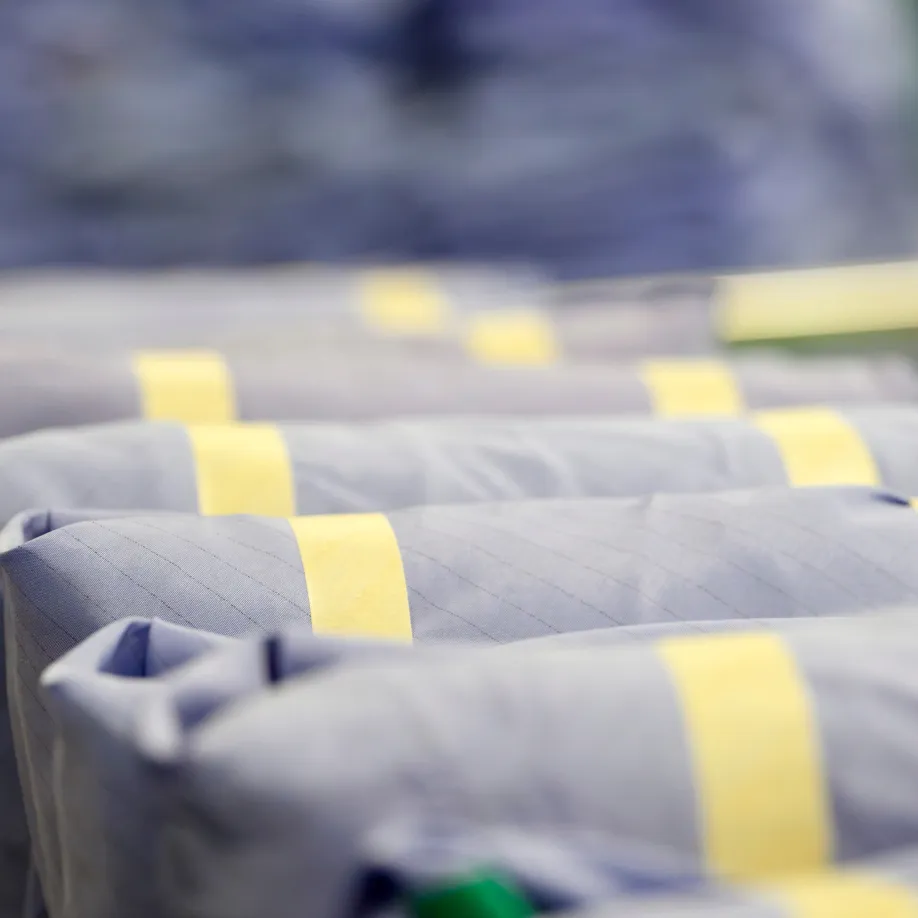
Within dedicated Blue Rooms, reusable healthcare linen is inspected, folded, assembled into packs and wrapped under controlled conditions. Each pack is then sterilised through a validated cycle, batch-recorded, checked and securely sealed to protect its integrity through storage, delivery and until the point of use.
These capabilities can support selected reusable surgical gowns, drapes, wraps and procedure packs where sterile processing is required. Sterilisation services are currently available in Victoria and New Zealand only and remain subject to product, facility and service capability.
Reusable Bluey pads do not ordinarily require sterile processing. This section relates to Ensign’s broader capabilities for eligible reusable healthcare and theatre products.
These capabilities form part of Ensign’s wider healthcare and theatre product offering, which includes reusable theatre products, patient apparel, ward linen and other products designed around healthcare requirements.
A managed approach to reusable healthcare products
Reusable Bluey pads represent one part of a broader opportunity to reduce reliance on selected single-use products.
A successful reusable program requires the right product, approved usage protocols, controlled laundering, reliable supply, appropriate stock levels and clear accountability across the complete product lifecycle.
Ensign brings these elements together through managed healthcare linen programs that can include:
- Reusable patient-care products, including Bluey pads
- Ward linen and patient apparel
- Reusable surgical gowns, drapes and wraps
- Controlled commercial laundering
- Hygiene and infection-prevention workflows
- Sterile processing for eligible products where available
- Product inspection and quality management
- Stock monitoring and replenishment
- Scheduled collection and delivery
- Usage and service reporting
By coordinating products, processing, inventory and logistics within one managed program, healthcare organisations can explore reusable alternatives while maintaining focus on patient care, operational continuity and clinical-governance requirements.
Small product changes can support broader healthcare goals
Reusable Blueys demonstrate how reviewing one familiar, frequently used product can create an opportunity for measurable change.
The Australian ICU study provides encouraging evidence that reusable absorbent pads may offer a viable alternative to disposable Blueys in an appropriate clinical setting.
The findings indicate that reusable linen was not inferior to disposable linen in relation to pressure-injury incidence after adjusting for other patient factors. The study also reported strong acceptance among participating staff and the avoidance of approximately 496 kilograms of disposable-product waste over one year.
Further research is needed, including larger multicentre studies and complete lifecycle assessments. However, the findings demonstrate what can be achieved when frequently used healthcare products are reviewed through patient-care, operational and sustainability lenses.
For healthcare organisations, the objective is not simply to replace a disposable product. It is to establish a safe, practical and well-managed reusable program supported by suitable products, clear usage guidance, staff education, controlled laundering and reliable supply.
Explore reusable patient-care solutions
Ensign works with public and private hospitals, day surgeries and other healthcare providers to develop managed linen and reusable-product programs around their clinical, operational and continuity requirements.
Explore Ensign’s healthcare solutions or contact our team to discuss reusable Bluey pads and other patient-care products.
Primary CTA: Explore our healthcare solutions
CTA link: https://www.ensignservices.com.au/sectors/healthcare
Secondary CTA: Talk to our healthcare team
CTA link: https://www.ensignservices.com.au/contact
Source
Feely K, Matthews S, Quilas E, McGain F, Kwek E and Wynne R. “Implementation of reusable linen in the intensive care unit: Impact on pressure injury, staff satisfaction, and environmental sustainability.” Australian Critical Care. 2025;38:101311.