How to Choose Commercial Floor Mats for Your Workplace
October 1, 2026
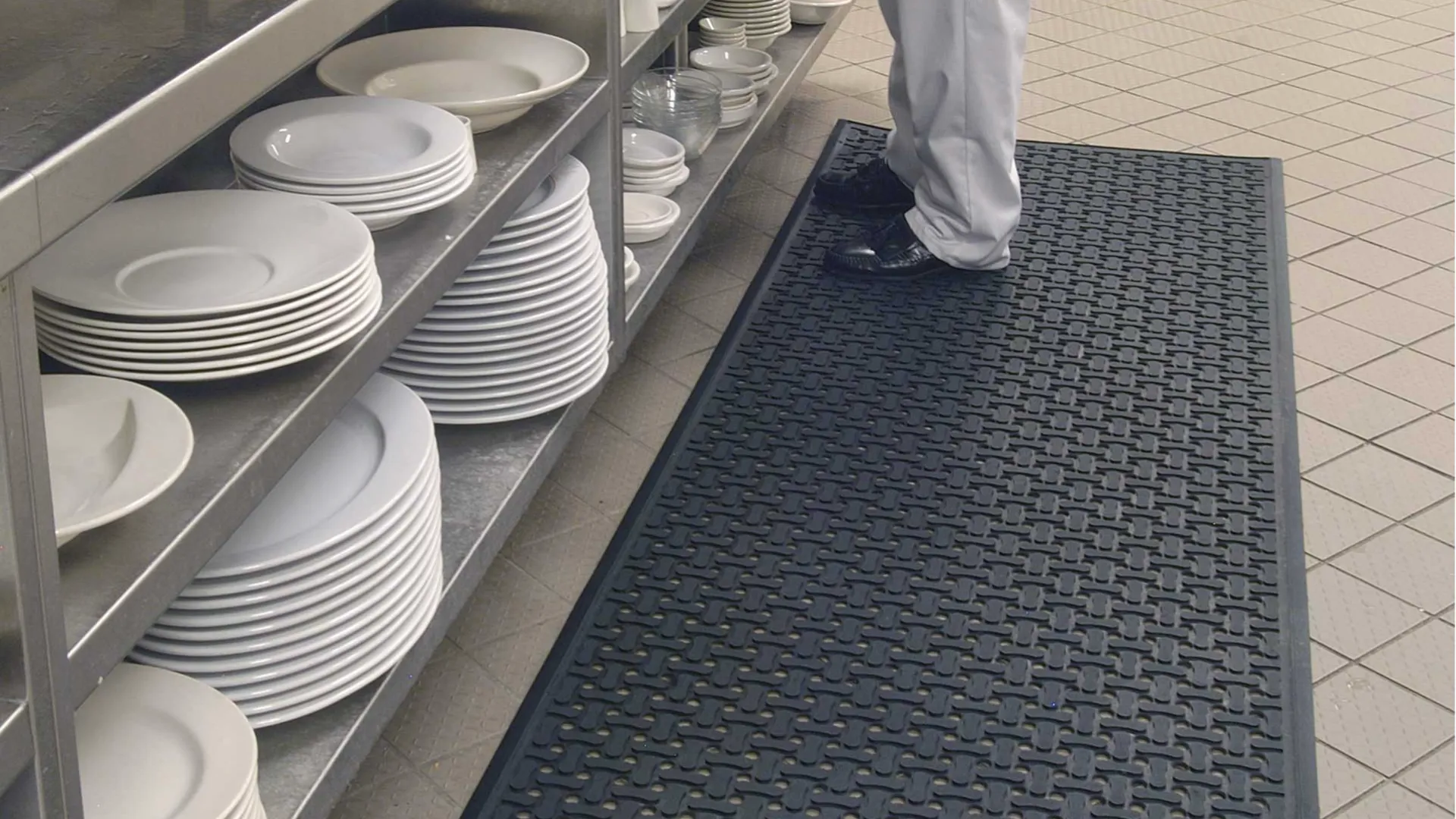
How to choose commercial floor mats for different workplace areas
Commercial floor mats are not one-size-fits-all products.
A mat positioned at a hotel entrance serves a different purpose from one used in a commercial kitchen, production area or employee workstation. The right product will depend on where it is placed, the type of traffic it receives, the conditions in the area and the outcome the business needs to support.
Selecting the right mat for each workplace area can help manage dirt and moisture, support safer movement, improve presentation and provide greater comfort for employees who spend long periods standing.
This guide explains the main types of commercial floor mats and the factors to consider when selecting them.
Why do workplaces use commercial floor mats?
Commercial mats can perform several different functions.
Depending on the product and its location, a floor mat may help:
- Capture dirt and moisture at entrances
- Keep reception and customer-facing areas presentable
- Provide traction in areas exposed to water or spills
- Support employees who stand for extended periods
- Protect flooring in high-traffic areas
- Define particular work or service zones
- Reduce the movement of dirt through a building
- Support broader workplace cleaning and floor-care processes
No mat can replace appropriate cleaning, maintenance and workplace risk controls. It should form part of a broader approach that includes regular inspection, prompt spill management and clear internal responsibilities.
Start with the workplace area
Before selecting a mat, consider exactly where it will be used.
Ask:
- Is the area indoors, outdoors or exposed to both conditions?
- Will the mat encounter water, grease, dirt or other substances?
- Is the area used by employees, customers, equipment or trolleys?
- How much foot traffic does it receive?
- Will employees stand in one position for long periods?
- What type of flooring sits beneath the mat?
- How often can the mat be cleaned or exchanged?
- Could mat placement affect doors, walkways or equipment movement?
- Are there site-specific safety or operational requirements?
Answering these questions helps narrow the selection to a product designed for the location and intended use.
Commercial entrance mats
Entrances are one of the most common locations for commercial floor mats.
People can carry water, dust, mud and other debris into a building on their footwear. A suitable entrance mat helps capture some of this material before it moves further into the premises.
Commercial entrance mats can be used in:
- Hotels and accommodation properties
- Restaurants and hospitality venues
- Healthcare and aged care facilities
- Offices and reception areas
- Retail premises
- Entertainment venues
- Manufacturing facilities
- Warehouses and operational sites
When selecting an entrance mat, consider:
- Expected foot traffic
- Exposure to rain and outdoor conditions
- The amount of dirt or moisture typically entering the building
- Available floor space
- Door clearance
- Floor surface
- Presentation requirements
- Cleaning and replacement frequency
A small mat may not provide enough contact area in a busy entrance. Larger entry zones may require more extensive matting or a combination of products to capture coarse debris and moisture progressively.
For hotels and other guest-facing properties, mat appearance should also complement the surrounding entrance and reception environment.
Mats for reception and customer-facing areas
Mats used in reception areas, foyers and customer-facing spaces need to balance function with presentation.
These locations often experience frequent traffic while forming part of the visitor’s first impression of the organisation.
Important considerations include:
- Colour and visual appearance
- Mat condition
- Edge profile
- Compatibility with surrounding flooring
- Foot-traffic volume
- Movement of luggage, trolleys or mobility aids
- Cleaning frequency
- Correct positioning
The mat should sit securely and remain flat. It should also be inspected regularly for movement, curling, wear or damage.
Customer-facing mats may be suitable for accommodation and hospitality properties, offices, healthcare settings, entertainment venues and other public spaces.
Safety mats for wet or spill-prone areas
Some workplace areas are regularly exposed to water, food, oils or other substances.
Safety or full-rubber mats may be suitable for locations such as:
- Commercial kitchens
- Food preparation areas
- Wash-up areas
- Bars and beverage stations
- Industrial work zones
- Utility rooms
- Selected production areas
- Other wet operational spaces
Depending on the design, these mats may provide drainage and a more suitable standing surface in areas where moisture is likely to accumulate.
The product should be selected according to the actual conditions. A mat suitable for water may not necessarily be appropriate for oils, grease, chemicals or specialised industrial substances.
Before selecting a safety mat, consider:
- The substances present in the area
- Frequency and volume of spills
- Cleaning processes
- Required drainage
- Surface texture
- Mat material
- Resistance to the operating environment
- Employee footwear
- Movement of equipment and trolleys
- Site-specific risk requirements
Mats should not be used as a substitute for repairing leaks, maintaining flooring or responding promptly to spills.
Anti-fatigue mats for standing workstations
Employees in manufacturing, hospitality, healthcare, retail and other sectors may spend extended periods standing in one place.
Anti-fatigue mats are designed to provide a more supportive standing surface at fixed or semi-fixed workstations.
They may be considered for:
- Production stations
- Assembly areas
- Packing benches
- Service counters
- Reception desks
- Commercial kitchen workstations
- Bar areas
- Checkouts
- Laboratories
- Other standing roles
When choosing an anti-fatigue mat, assess:
- How long employees typically stand
- Whether the employee remains stationary or moves frequently
- The flooring beneath the mat
- The workstation layout
- Employee footwear
- Exposure to water, oils or other substances
- Cleaning requirements
- Mat thickness and edge design
- Movement of carts, equipment or stock
A mat should not create an obstruction around the workstation. Its size and positioning need to support the employee’s usual movement without interfering with nearby equipment or walkways.
Anti-fatigue matting should form part of a broader ergonomic review that may also consider task design, work height, footwear, movement and rest breaks.
Mats for commercial kitchens and food-service areas
Commercial kitchens combine frequent movement, standing tasks and potential exposure to water, food and grease.
A mat used in these areas needs to be selected for the specific workstation and operating conditions.
Potential locations include:
- Food preparation stations
- Cooking areas
- Wash-up zones
- Beverage stations
- Service counters
- Back-of-house entry points
Key considerations include:
- Heat exposure
- Grease and oil
- Water and cleaning chemicals
- Drainage
- Cleaning frequency
- Employee movement
- Trolley access
- Food-service hygiene processes
The appropriate mat may vary between areas within the same kitchen. A product used at a preparation bench may have different requirements from one placed near a washing area.
Mats should be incorporated into documented cleaning and inspection processes so that dirt or moisture does not build up beneath or around them.
Mats for industrial and manufacturing workplaces
Industrial and manufacturing workplaces can include entrances, production lines, packing stations, workshops, warehouses and employee service areas.
Each area may require a different floor-care solution.
For example:
- Entrance mats may help capture external dirt and moisture.
- Anti-fatigue mats may support employees at standing workstations.
- Safety mats may be considered in wet operational areas.
- Rubber mats may suit selected heavy-duty environments.
- Customer-facing mats may be used in reception and office areas.
Product selection should account for the workplace’s processes and risks.
Important questions include:
- Will forklifts, pallet jacks or trolleys pass through the area?
- Could the mat come into contact with oils or chemicals?
- Is the floor regularly wet?
- Does the workstation generate offcuts or debris?
- How will the mat be cleaned?
- Could the mat move during normal operations?
- Are specialist resistance or performance properties required?
The mat should be assessed within the organisation’s broader workplace risk-management process.
Mats for healthcare and aged care environments
Healthcare and aged care environments require careful consideration of hygiene, access and movement.
Mats may be used at:
- External entrances
- Reception areas
- Staff entrances
- Service areas
- Kitchens
- Selected workstations
When selecting mats for these environments, consider:
- Movement of residents, patients and visitors
- Mobility aids and wheelchairs
- Beds, carts and other wheeled equipment
- Cleaning and hygiene requirements
- Mat edges and surface condition
- Foot-traffic levels
- Placement in relation to doorways
- Inspection and exchange frequency
Mats should be positioned carefully so they do not obstruct movement or interfere with operational workflows.
They should also be included in regular cleaning and condition checks.
Mats for hotels and hospitality venues
Hotels, restaurants, clubs and entertainment venues can experience heavy and highly variable foot traffic.
Mats may be used at:
- Main entrances
- Staff entrances
- Reception areas
- Loading and service areas
- Commercial kitchens
- Bars
- Food-service stations
- Back-of-house workstations
For customer-facing locations, presentation and condition are especially important. A worn or poorly positioned mat can detract from an otherwise well-maintained entrance.
Back-of-house products should be selected around the actual working environment, including exposure to moisture, food, grease and prolonged standing.
A coordinated hospitality linen and product service can help venues manage floor-care products alongside uniforms, dining linen and kitchen textiles.
Size and placement matter
Selecting the right type of mat is only part of the decision. Its size and placement also affect how well it functions.
A mat should:
- Provide enough coverage for the intended area
- Sit flat against the floor
- Allow doors to open and close correctly
- Avoid blocking walkways
- Accommodate the expected movement through the space
- Remain stable under normal use
- Avoid interfering with trolleys or equipment
- Be accessible for cleaning and inspection
Entrances may require enough matting for several footsteps rather than a single step. Standing workstations need sufficient coverage for the employee’s normal working movement.
Incorrect sizing can reduce the mat’s effectiveness or create new operational issues.
Mat cleaning, inspection and replacement
Commercial mats require ongoing care.
The appropriate cleaning frequency will depend on:
- Foot-traffic volume
- Weather conditions
- Workplace activity
- Exposure to spills
- The mat’s location
- The type of debris collected
- Presentation and hygiene requirements
Mats should be checked for:
- Excessive dirt or moisture
- Movement
- Curling or raised edges
- Cracks or splits
- Surface wear
- Damage to the backing
- Loss of shape
- Conditions that may affect use
A managed floor-care service can coordinate the supply, collection, cleaning and scheduled exchange of suitable mats according to workplace requirements.
Regular service helps prevent heavily soiled or damaged mats from remaining in use beyond an appropriate interval.
Should a business rent or purchase commercial floor mats?
The right ownership model depends on the number of mats, their intended use and the business’s ability to manage cleaning and replacement.
Purchasing mats
Direct purchase may suit businesses that:
- Need only a small number of products
- Have internal cleaning capability
- Require a highly specialised product
- Prefer to own and manage their floor-care inventory
The business remains responsible for cleaning, condition monitoring and replacement.
Managed mat services
A managed service may suit businesses that:
- Use mats across several workplace areas
- Need regular collection and cleaning
- Operate across multiple locations
- Want scheduled replacement or exchange
- Prefer to reduce internal administration
The service arrangement should clearly identify which products, cleaning frequencies, delivery schedules and replacement responsibilities are included.
Questions to ask a commercial mat provider
Before selecting a provider, ask:
- Which type of mat is recommended for each workplace area?
- Is the product suitable for the substances and conditions present?
- What sizes and configurations are available?
- How should the mat be positioned?
- How often should it be cleaned or exchanged?
- How will worn or damaged mats be identified?
- Are collection, cleaning and delivery included?
- Can service frequency change as requirements change?
- Can the provider support multiple locations?
- Who is responsible for inspecting mats between services?
- What should staff do if a mat moves or becomes damaged?
- Are there site-specific limitations or requirements?
The provider should assess the workplace rather than recommending the same product for every area.
Choosing the right mat for each area
Commercial floor mats can support presentation, floor care, employee comfort and safer workplace movement—but only when the product is appropriate for its location.
Entrance mats, safety mats, anti-fatigue mats and rubber mats perform different functions. The right choice depends on foot traffic, moisture, contaminants, standing time, equipment movement and the surrounding environment.
A workplace review can help identify where mats are needed, which products are suitable and how frequently they should be cleaned, inspected or exchanged.
Commercial floor-care solutions from Ensign
Ensign provides cleaning, floor-care and washroom products for commercial and operational environments.
The range can include entrance mats, safety mats, full-rubber mats and anti-fatigue mats, alongside microfibre cloths, mops, roller towels and related products.
Solutions can be tailored around the workplace, intended use, service frequency and broader cleaning requirements.
Discuss your floor-care requirements
Frequently asked questions
What is the best type of commercial entrance mat?
The appropriate entrance mat depends on foot traffic, exposure to weather, the amount of dirt and moisture entering the building, available space and presentation requirements. Busy or exposed entrances may require larger or staged matting.
What is the difference between an entrance mat and a safety mat?
An entrance mat is generally designed to capture dirt and moisture brought into a building. A safety mat is intended for operational areas exposed to water, spills or other workplace conditions. Product suitability depends on its design and material.
Where should anti-fatigue mats be used?
Anti-fatigue mats may be considered at workstations where employees stand for extended periods, including production lines, packing benches, service counters and commercial kitchens. Placement should account for the task, flooring, employee movement and surrounding equipment.
Can commercial floor mats be professionally cleaned?
Yes. Suitable commercial mats can be incorporated into a managed service that includes scheduled collection, cleaning, inspection and return. The available service will depend on the mat type and operating environment.
How often should commercial mats be cleaned?
Cleaning frequency depends on traffic, weather, spills, workplace activity and presentation requirements. Mats should also be inspected between services and addressed promptly if they become heavily soiled, wet, damaged or displaced.
Can one type of mat be used throughout a workplace?
Usually not. Entrances, wet areas, kitchens, service counters and industrial workstations have different conditions. Each location should be assessed so the selected mat is appropriate for its intended use.